
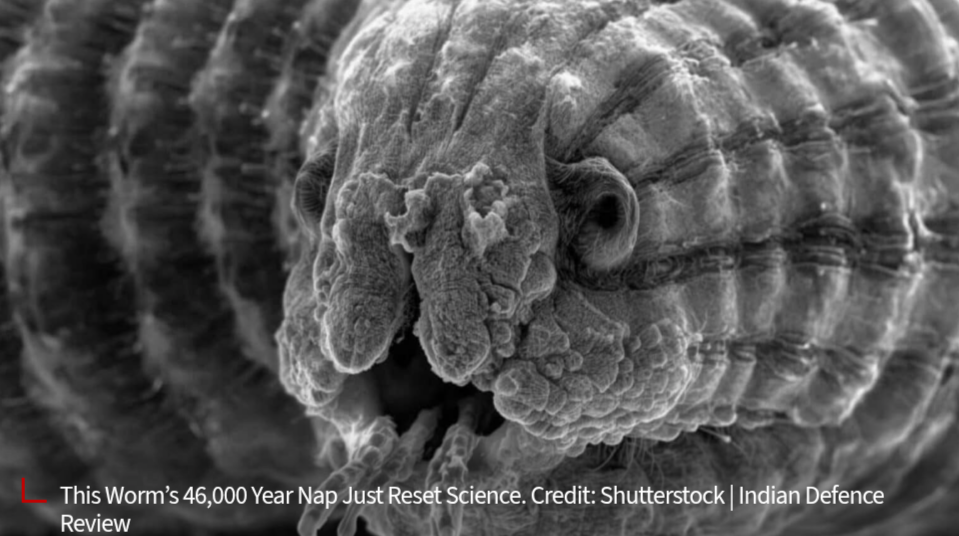
Scientists have revived a microscopic organism that remained frozen for approximately 46,000 years in Siberian permafrost, an achievement that is redefining scientific understanding of survival, dormancy, and the limits of life itself.
Recovered from Pleistocene-era sediments near the Kolyma River, the revived worm resumed movement and feeding shortly after thawing, behaving as though its tens of thousands of years in ice were merely an extended pause.
Siberian Permafrost: Earth’s Natural Time Capsule
Siberia’s permafrost is widely regarded as one of the most reliable natural archives of Earth’s past. Its permanently frozen layers preserve biological and environmental records with minimal disturbance, making it invaluable for reconstructing ancient climates and ecosystems.
Until now, scientists expected to find only dead biological remains, fossils, DNA fragments, or chemical traces. The revival of a living organism from such depths has fundamentally challenged that assumption.
A New Species from the Ice Age
The research was conducted by scientists from Russian research institutions in collaboration with the University of Cologne’s Institute of Zoology. Their peer-reviewed findings were published in PLOS Genetics.
Radiocarbon dating of plant material embedded in the same sediment layer confirmed an age of approximately 46,000 years, firmly placing the organism in the Pleistocene epoch. Strict laboratory controls ruled out modern contamination.
Genomic analysis revealed the organism to be a previously unknown species of nematode, now named Panagrolaimus kolymaensis.
How the Worm Survived for 46,000 Years
The worm’s extraordinary endurance is explained by cryptobiosis, a rare biological state in which metabolic activity drops to nearly zero. In this condition, organisms can withstand extreme cold, dehydration, radiation, and oxygen deprivation.
Researchers found that P. kolymaensis relies heavily on trehalose, a sugar molecule that forms a protective, glass-like structure inside cells. This stabilizes DNA, proteins, and membranes, preventing damage during prolonged freezing.
Notably, the genetic mechanisms responsible for cryptobiosis closely resemble those found in some modern nematodes, indicating that this survival strategy is ancient and evolutionarily conserved.
Is There a Maximum Limit to Frozen Survival?
While the revival is unprecedented, the study also suggests potential biological limits. Scientists reported no signs of life in older permafrost layers, implying that cryptobiosis may have a finite survival window under natural conditions.
Based on current evidence, the upper boundary for survival in frozen permafrost may be close to 46,000 years, though future discoveries could extend this threshold further.
Links to Tardigrades and Space Survival Research
This finding aligns with decades of research on other extremophiles, particularly tardigrades, which are known to survive the vacuum of space, intense radiation, and extreme temperatures by entering cryptobiotic states.
Space agencies, including NASA, have demonstrated that complex life forms can remain dormant under conditions similar to those found beyond Earth. Together, these discoveries suggest that extreme biological suspension is not unique, but a repeatable evolutionary solution.
Astrobiology and Planetary Protection Implications
The ability of complex organisms to survive frozen for tens of thousands of years has major implications for planetary protection policies.
Space missions targeting icy worlds such as Mars, Europa, or Enceladus must ensure stringent sterilization procedures to avoid transporting Earth-based organisms capable of long-term dormancy.
The discovery also adds credibility to discussions around panspermia, the hypothesis that life could travel between planets in a dormant state.
Potential Applications in Medicine and Biotechnology
Understanding cryptobiosis at the molecular level could lead to breakthroughs in:
- Long-term organ and tissue preservation
- Cryogenic medicine
- Stabilization of vaccines and biomaterials
- Radiation resistance technologies
Nature’s own preservation systems may provide templates for next-generation biomedical innovation.
A Discovery That Redefines Life’s Limits
The revival of Panagrolaimus kolymaensis raises a fundamental scientific question:
Is extreme long-term dormancy rare, or widespread but undiscovered?
As climate change exposes deeper permafrost layers and research techniques advance, more dormant organisms may yet be revealed. One thing is already certain, this 46,000-year-old worm has permanently expanded our understanding of how resilient life can be.